

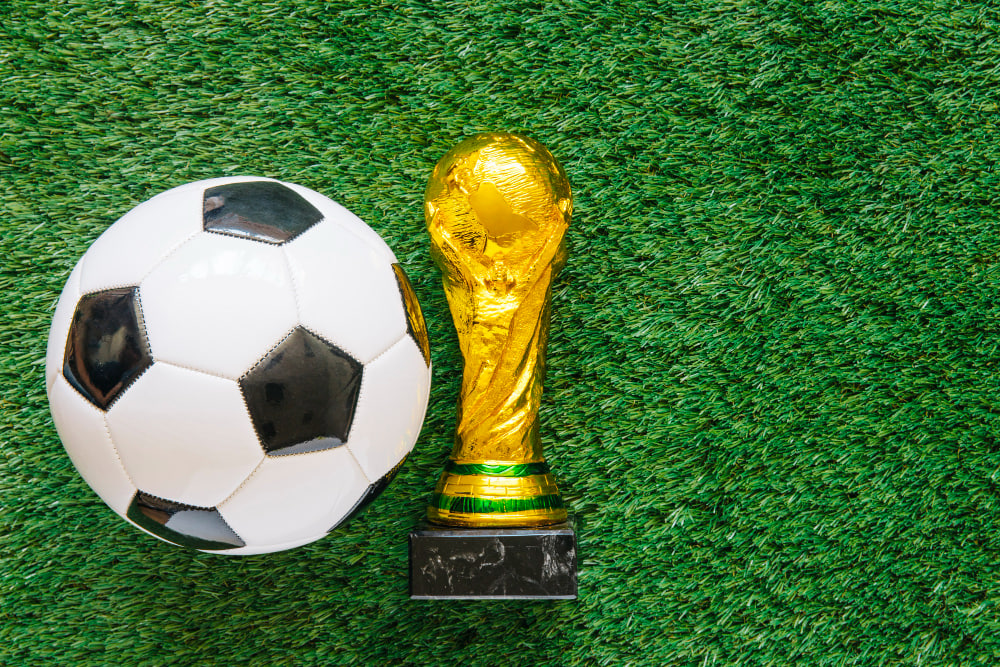
It is the most recognized sports symbol on the planet. Standing at just 36.8 centimeters tall, this piece of gold represents the dreams of billions of people. But the history of the World Cup trophy is far from a simple fairy tale. It is a saga filled with theft, war, unsolved mysteries, and a dog named Pickles.
While fans dream of seeing their captain lift the trophy, few know the dark and chaotic journey this object has taken over the last century. From surviving World War II in a shoe box to being melted down by thieves in Rio de Janeiro, the prize has seen more action off the pitch than on it. In this deep dive, we explore the fascinating, and often dangerous, legacy of the most coveted object in sports. Read: Top 10 Biggest Football Underdog Stories That Shocked the World
The Original Prize: The Jules Rimet Trophy
To understand the history of the World Cup trophy, we must go back to 1930. The first trophy wasn’t the one we see Lionel Messi or Kylian Mbappé holding today. It was a completely different design, originally named “Victory.”
Designed by French sculptor Abel Lafleur, it depicted Nike, the Greek Goddess of Victory, holding an octagonal cup. It was made of gold-plated sterling silver and lapis lazuli. In 1946, it was renamed the Jules Rimet Trophy in honor of the FIFA president who founded the tournament.
This specific trophy had a turbulent life that could easily be the plot of a Hollywood thriller.
Surviving the Nazis (1939-1945)
During World War II, Italy held the trophy as the 1938 champions. As the war escalated, there was a genuine fear that the Nazis would seize the trophy, melt it down, or steal it as a symbol of superiority.
Dr. Ottorino Barassi, the Italian vice-president of FIFA and president of the Italian Football Federation, took matters into his own hands. He secretly removed the trophy from a bank vault in Rome. Barassi hid the trophy in a simple shoe box under his bed.
When the Gestapo (Nazi secret police) raided his home searching for the prize, they never thought to look in the dusty old box beneath where he slept. Barassi’s bravery ensured the history of the World Cup trophy continued post-war.
The Great Heist of 1966: Enter “Pickles”
The trophy’s troubles were far from over. Ahead of the 1966 World Cup in England, the Jules Rimet was put on display at Westminster Central Hall in London. Despite being guarded, thieves managed to break into the display case on March 20, 1966.
The trophy vanished.
Panic set in. England was about to host the world, and they had lost the prize. A ransom note demanding £15,000 was sent to the FA (Football Association), but police investigations hit a dead end. The embarrassment for the hosts was immeasurable.
Seven days later, a man named David Corbett was walking his dog, a mixed-breed collie named Pickles, in South London. Pickles began sniffing intensely around a bush near a garden hedge.
“He was sniffing at this package, wrapped in newspaper,” Corbett recalled. “I tore the paper slightly and saw a woman holding a dish over her head… and the words Brazil and Germany.”
Pickles had found the World Cup. The dog became an instant national hero, arguably more famous than the players themselves. He was given a year’s supply of dog food and even starred in a movie. This bizarre chapter is a fan favorite in the history of the World Cup trophy.
The Mystery of 1983: Gone Forever?
In 1970, Brazil won the World Cup for the third time (having won in 1958 and 1962). According to Jules Rimet’s original rules, any nation that won the tournament three times would get to keep the trophy permanently.
The trophy was flown to Brazil, where it was displayed in the headquarters of the Brazilian Football Confederation (CBF) in Rio de Janeiro, protected by bulletproof glass. However, the back of the cabinet was made of wood.
On the night of December 19, 1983, thieves broke into the office, pried open the wooden back, and stole the Jules Rimet trophy. Unlike in 1966, there was no Pickles to save the day.
Despite police arrests, the trophy was never recovered. The widely accepted theory is that the thieves melted it down to sell the gold. The original symbol of football history was lost forever. Today, the piece sitting in the Brazilian museum is merely a replica.
The New Era: The FIFA World Cup Trophy (1974-Present)
With the Jules Rimet given to Brazil, FIFA needed a new trophy for the 1974 World Cup in West Germany. They received 53 submissions from sculptors in seven countries.
The winner was Italian artist Silvio Gazzaniga. His design is the iconic trophy we know today.
Design and Specifications
Gazzaniga’s creation is structurally different from its predecessor:
- Material: 18-karat gold.
- Weight: 6.175 kilograms (13.61 lbs).
- Height: 36.5 centimeters.
- Design: Two human figures spiraling up from the base, holding the Earth in their hands.
The base contains two layers of semi-precious malachite (a green mineral), chosen to represent the green of a football pitch.
“The lines spring out from the base, rising in spirals, stretching out to receive the world,” Gazzaniga described.
Unlike the Jules Rimet, the current rules state that no country can keep this trophy permanently, regardless of how many times they win. The winners receive a gold-plated bronze replica (called the “Winner’s Trophy”), while the original remains in FIFA’s possession at the FIFA World Football Museum in Zurich.
Who Is Allowed to Touch It?
The exclusivity of the trophy adds to its mystique. FIFA maintains strict protocols regarding the history of the World Cup trophy and its handling.
Only a select group of people are allowed to touch the original trophy with their bare hands:
- Players of the winning team (during the ceremony).
- Former World Cup winners.
- Heads of State (Presidents, Monarchs, and Popes).
This rule led to a famous controversy during the 2022 World Cup final, when celebrity chef “Salt Bae” was seen touching and kissing the trophy on the pitch, sparking outrage among fans and officials. It highlighted just how sacred this object is to the football community.
The Hidden Names
If you look at the bottom of the trophy, there is a plate engraved with the names of the winning countries since 1974.
- 1974: West Germany
- 1978: Argentina
- 1982: Italy
- 1986: Argentina
- …and so on.
However, there is a logistical problem looming. The base of the trophy only has space to engrave the winners until the 2038 World Cup. After that tournament, the plate will be full. FIFA will effectively run out of space.
Will they add a new base? Will they commission a third trophy design? It is a future mystery in the history of the World Cup trophy that has yet to be written.
[Image Placeholder: Close up of the base of the current World Cup Trophy]
-
Alt Text: The base of the current trophy showing engraved names of winners in the history of the World Cup trophy.
Conclusion
From the heroism of Dr. Barassi to the nose of Pickles the dog, and the tragedy of the meltdown in Rio, the World Cup trophy is more than just a cup. It is a witness to history.
It has survived wars, crossed oceans, and been held by the greatest legends like Maradona, Zidane, and Ronaldo. While the design may have changed, the obsession remains the same. It is the one object that stops the world every four years.
As we look forward to the next tournament, one wonders: what new chapter will be added to this incredible story?
Did you know about Pickles the dog? Share this story with a friend who thinks they know everything about football!

